
Article: Trend Decoded : Skin Flooding
Trend Decoded : Skin Flooding
Skin Flooding
A returning ritual, decoded by science, and built into every Gressa formulation. What you already own may be all you need.
Skin flooding is one of those practices that resurfaces every few years under a different name. The core idea is always the same: layer your skincare on damp skin, thinnest to richest, and finish with something that seals it all in. Each time it comes back around, more people discover what a difference the sequence makes — and it does make a difference. The results are real.
What we want to share here is the science behind why it works, and how botanical skincare — specifically the way Gressa formulates — is particularly well suited to this approach. You do not need to follow a trend to get the benefit. You just need to understand the sequence, and choose the right products for each step.
Why it actually works
When skin is damp, the outermost layer behaves differently. The cells swell slightly, and the spaces between them open up. This creates a natural concentration gradient — the surface is wetter than the layers beneath, and your actives follow that gradient inward, the way water finds its level. You are not forcing anything. The biology does the work.
Studies have shown that absorption of topically applied compounds can increase by as much as four times on hydrated skin versus dry. That is not a small difference. It is the difference between a product sitting on the surface and a product actually delivering where it needs to go.
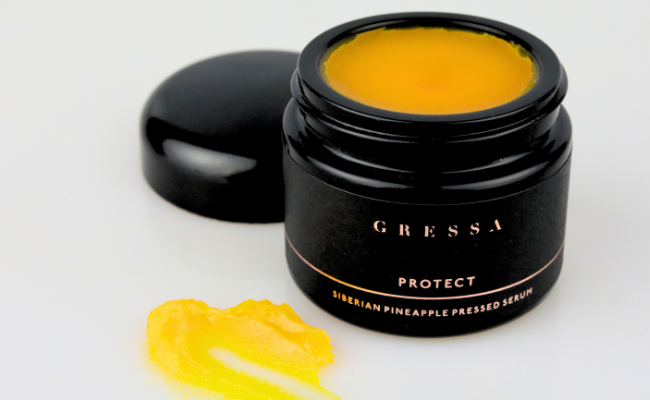
The pressed serum at the end closes the process. For a botanical pressed serum like Siberian Pineapple, that final step is doing two things at once — sealing the surface so nothing escapes, and continuing to repair and nourish through the night. The sequence is not arbitrary. It follows the skin's own logic.
A practice that keeps returning
What is interesting about this practice is how consistently it appears across cultures and centuries. Egyptian, Ayurvedic, Chinese, Korean — each arrived independently at the same sequence. That kind of convergence is usually a sign that something genuinely works. The skin responds the same way regardless of geography or era.
The sequence — step by step
Below is the full Gressa sequence — each step with the product that belongs there, and the reason why. Botanical formulations work particularly well with this approach because they are built around whole plant actives that respond to the skin's own moisture rather than working against it.
Cleanse. Stay damp.
Rinse and resist the towel. A gentle press is fine — but skin should still be visibly damp when toner touches it. Everything begins here.
Tone on damp skin.
Pat in — do not wipe. A toner on damp skin amplifies absorption by maintaining the moisture gradient. This is the step most people rush. Take your time with it.
Treat. The active layer.
While the channels are still open, this is the moment for your treatment oil. Lightweight, nutrient-dense, and designed to travel. It reaches the skin at its most receptive.
Moisture. The comfort layer.
A cream or balm over oil. This is the knitwear of your routine — placed over the finer inner pieces to hold everything in place and cushion the skin.
Seal. The final gesture.
The pressed serum closes the door. Nothing already delivered has anywhere to go but in. This step is doing two things at once — sealing the surface and continuing to repair through the night.
You do not need to follow a trend to see the results. You just need the right sequence, and the right products at each step. Everything listed above was formulated to work together — not because we anticipated this trend, but because the skin was always asking for it and good formulation listens.


Leave a comment
This site is protected by hCaptcha and the hCaptcha Privacy Policy and Terms of Service apply.